Wholesalers
Buying a wholesale business?
We arrange the finance. You get the keys.
A wholesale business is built on the dependable movement of stock between suppliers and trade customers — and lenders who understand the sector assess it accordingly. The strongest acquisitions combine repeat trade orders, disciplined stock control, sensible credit terms, and a customer base that is not overly dependent on any single account. A well-run wholesale operation with strong gross margins, efficient stock turn, and a loyal trade customer base is a more fundable proposition than many buyers expect.
What lenders look at
Gross margin and stock turn are the foundation. Lenders will examine the gross margin across the product range, the average stock turn rate, and how efficiently the business converts inventory into cash. A wholesale business with strong gross margins — appropriate to its product category — and a stock turn rate that minimises tied-up working capital is a more fundable proposition than one with thin margins and slow-moving stock. Lenders will also assess the product mix — a diversified range across multiple categories is more resilient than one dependent on a narrow product line or a single supplier relationship.
Debtor quality and credit control are assessed carefully. Most wholesale businesses extend trade credit to their customers — the debtor book represents a significant working capital asset that affects both the funding structure and the lender's risk assessment. Lenders will examine the age profile of the debtor book, the average debtor days, the proportion of overdue debt, and the creditworthiness of the key trade accounts. A clean, well-managed debtor book with low overdue balances and creditworthy customers is a strong asset. A debtor book with high aged debt or concentration in a small number of accounts carries a risk that lenders price carefully. Invoice finance against the debtor book can often be arranged alongside the acquisition loan as part of the overall funding package.
Supplier relationships and terms are reviewed as part of the overall deal. The terms on which the business buys from its suppliers — payment terms, volume rebates, exclusive distribution agreements, and minimum order commitments — directly affect both the margin and the working capital cycle. Lenders will want to understand the key supplier relationships, the terms on which stock is purchased, and whether those relationships and terms transfer to the incoming owner. An exclusive distribution agreement or a favoured supplier relationship that does not transfer automatically is a risk that needs to be addressed directly in the application.
Seasonal working capital needs are assessed alongside the annual trading position. Many wholesale businesses have pronounced seasonal peaks — demand that concentrates in specific months needs additional stock funding ahead of the peak and generates cash after it. Lenders familiar with wholesale operations understand this cycle and assess the peak working capital requirement alongside the annual average. A business with well-managed seasonal funding — whether through an overdraft facility, a stock finance line, or invoice finance — is a more confident lending proposition than one that has historically struggled with peak working capital pressure.
How we help
We are acquisition finance and loans brokers, not lenders. We package your application, present it to the funders with genuine wholesale sector appetite, and manage the process from first conversation through to completion.
We also arrange government-backed facilities for wholesale business acquisitions — helping buyers access up to £2 million toward their purchase where the criteria are met.
Every wholesale acquisition is different. Tell us about the business. We will take it from there.
For the wider funding options, explore business acquisition finance.
01 — Who we help
First-time buyers, experienced operators, and everyone in between
First-time wholesale buyers
Experienced sales, purchasing and operations managers moving into ownership of an established distributor.
Existing wholesalers expanding
Operators acquiring a competitor, a complementary product range or an additional distribution territory.
Trade buyers
Manufacturers, retailers and service groups acquiring a wholesale supplier to strengthen their wider supply chain.
Management buyouts
Leadership teams buying the wholesale business they already understand, supported by continuity across suppliers and customers.
02 — The opportunity
What can we help you buy?
We arrange acquisition finance and loans for wholesale businesses across the UK — from specialist importers and regional distributors to established cash-and-carry operations.
Specialist product wholesalers
Focused distributors with deep product knowledge, established supplier relationships and a loyal trade customer base. The asking prices for leasehold and freehold wholesale businesses typically range from £150,000 to £5m.
Food and drink wholesalers
Ambient, chilled and specialist distributors where stock control, food safety and delivery density are central to value.
Trade and building suppliers
Businesses supplying contractors and local trades through repeat accounts, branches and delivery services.
Import and distribution businesses
Wholesalers with established overseas suppliers, protected routes to market and careful foreign-currency management.
Cash-and-carry operations
Warehouse-led businesses combining immediate payment with a broad range of stock for independent trade customers.
Online and multi-channel wholesalers
Distributors combining account-led trade with ecommerce ordering, integrated stock systems and nationwide fulfilment.
Inside the operation
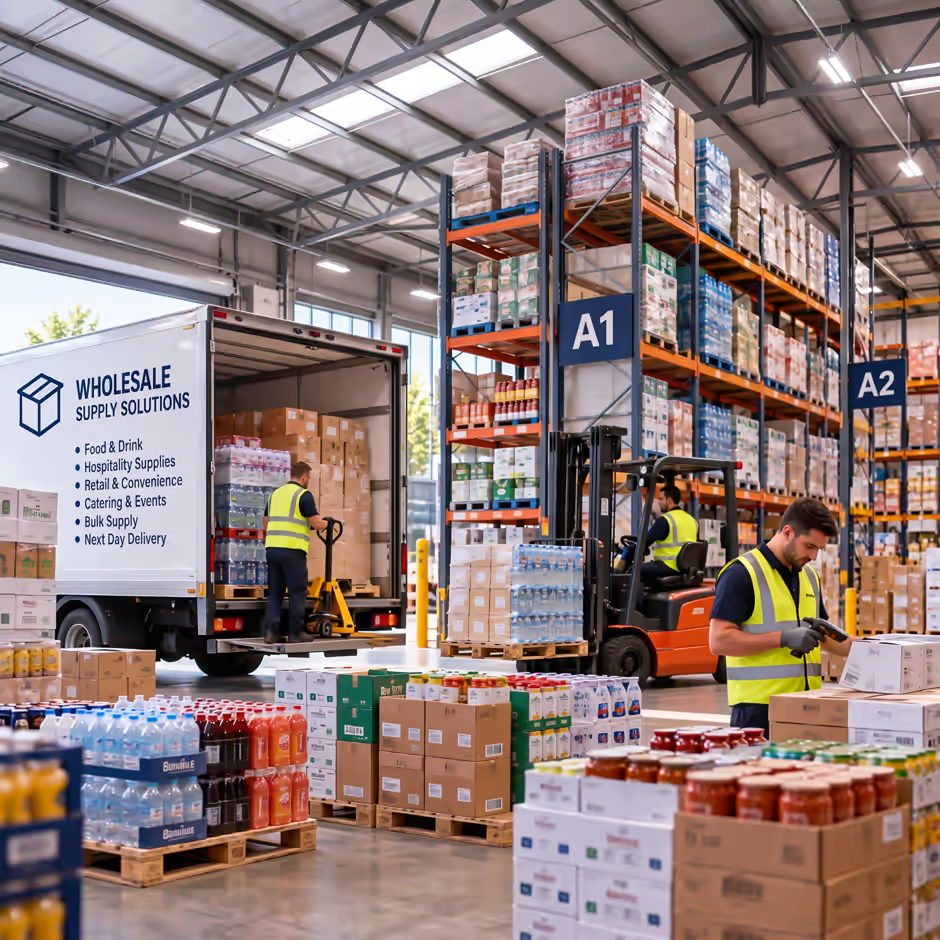
Warehouse and distribution in action
From racked storage and order picking to the loading bay and the delivery fleet, these are the operations lenders want to understand when you buy a wholesale business.




03 — The transaction
What can we finance?
The Business Purchase
Funding to buy a trading business, including goodwill and the business assets.
The Freehold
Funding for the purchase of the premises from which the business operates.
The Leasehold
Funding to buy a business operating from leased premises.
Fixtures, Fittings and Equipment
Where appropriate, funding can also take account of the assets required to operate the business.
Working Capital
Depending on the transaction, we can arrange funding for the initial working capital required after you take ownership.
Every deal is assessed on its own merits — not every element of every purchase will be financeable, and we'll tell you plainly what is and what isn't.
04 — The lender's view
What will lenders look at?
Lenders want to see a professionally prepared funding application. They want to know that the business is viable, that the proposed borrowing is affordable and that their loan can be repaid as agreed.
We use our proven iLendi Six™ method to build a strong funding application around the things lenders need to understand about your purchase.
Read more about the iLendi Six™05 — The funding
How much can you borrow?
Every purchase is different. The amount you can borrow will depend on the business, its trading performance, the purchase price, your circumstances and the structure of the transaction.
For wholesale businesses, lenders will focus on gross margin and stock turn, aged inventory, customer and supplier concentration, trade credit terms, debtor quality, warehouse and fleet commitments, and the working capital required to support normal and seasonal purchasing cycles.
We arrange funding across the UK and work with you to find the financing solution that best fits the purchase.
06 — The completion
The iLendi Approach
Three steps from finding the business to owning it.
01
The Discovery
You have just found the business you want. You tell us all about it.
02
The Finance
You need financing to buy the business; we find the money.
03
The Completion
We stay by your side through to legal work completion and the business is yours.
Common questions
Buying a wholesale business — your questions answered
How is a wholesale business valued?+
Wholesale businesses are usually valued on a multiple of maintainable earnings, adjusted for the quality of the stock, the debtor book and the customer base. Lenders look closely at gross margin, stock turn, aged inventory and customer concentration — a business with repeat trade accounts, disciplined stock control and no single dominant customer will generally support a stronger valuation and better funding terms than one reliant on a handful of accounts.
Can stock and working capital be included when buying a wholesale business?+
They can often be addressed as part of the overall funding structure. Acquisition finance and loans may sit alongside stock, revolving credit, invoice finance or asset finance facilities, depending on the quality of the inventory, debtor book and trading cycle.
How should I prepare before making an offer on a wholesale business?+
Start with the numbers: three years of accounts, a current stock valuation with ageing, an aged debtor listing and a breakdown of sales by customer. Understand the warehouse lease or freehold position, key supplier terms and any seasonal working-capital peaks. We help you shape this into a robust funding application before you commit, so your offer is backed by indicative terms rather than guesswork.
What does the sale and purchase process look like for a wholesale business?+
Once your offer is accepted, the process typically runs through heads of terms, lender due diligence and a formal offer, then legal work to completion. Stock is usually valued at or just before completion, so the final price can move with the count. We coordinate the funding alongside your solicitor and accountant, and where invoice or stock finance is part of the structure, the facilities are arranged in parallel so everything completes together.
How long does it take to arrange finance for a wholesale business purchase?+
Indicative terms are usually available within 48 hours of your enquiry. A formal offer typically follows within two to four weeks, depending on the complexity of the stock and debtor position. The overall timeline is often set by the legal work and the completion stock count rather than the finance itself.
How much deposit do I need to buy a wholesale business?+
Most wholesale business acquisitions are funded with a deposit of around 20% to 30% of the purchase price, though this varies with the strength of the trading figures, whether the deal includes freehold property, and your own experience. Where there is property security or a particularly strong trading history, lenders can sometimes go further.
Can I borrow against goodwill when buying a wholesale business?+
Yes. Specialist acquisition lenders will lend against goodwill where the trading history supports it, which is essential for leasehold deals with no bricks-and-mortar security. The application has to be presented so the underwriter can see the sustainable, transferable earnings behind that goodwill.
How long does it take to arrange finance to buy a wholesale business?+
Indicative terms are usually available within 48 hours of your enquiry. A full offer typically follows within two to four weeks, with completion driven mainly by valuation and the pace of the legal work on both sides.
Is iLendi Capital a lender or broker?+
iLendi Capital is an acquisition finance and loans broker, not a direct lender. We work with buyers across the UK to prepare their funding applications, introduce them to the lenders most likely to approve them, and manage the deal through to completion. We also specialise in government-backed facilities, helping you secure up to £2m toward your purchase.
Keep exploring
Related businesses we fund
Buyers of wholesalers often look at these neighbouring sectors too.
Found your wholesale business?
Let's find the finance.
Begin your funding process
Start with a conversation.
Tell us what you want to buy and an experienced funding specialist will call you back same day to discuss how we can help.
Other ways to contact us
Send an email:enquiries@ilendicapital.co.ukCall us: +44 (0)20 3488 8126We'll open WhatsApp with: "Hello iLendi Capital — I'm looking at buying a business and would like to talk."