Commercial Property
Buying a commercial property?
We arrange the finance. You get the keys.
Whether you are buying the property your business trades from or investing in commercial property for rental income, the funding principle is the same — the property itself provides the primary security, and the right lender will advance meaningfully against it. Offices, retail units, warehouses, industrial premises, and mixed-use buildings all fall within the scope of commercial property finance — and deal structures vary significantly depending on the asset type, the tenant, and the purpose of the purchase. Getting the structure right from the outset makes a significant difference to both the terms available and the speed of completion.
What lenders look at
Owner-occupier purchases are assessed on the trading performance of the occupying business. Where the buyer is purchasing premises for their own business to trade from, lenders will assess the business's financial performance — turnover, profitability, and debt serviceability — alongside the property value. The loan is structured as a commercial mortgage secured against the property, with the business's trading income providing the repayment source. A profitable, well-established business purchasing its own premises is a strong owner-occupier lending proposition.
Investment purchases are assessed on rental yield and tenant covenant strength. Where the buyer is purchasing commercial property as an investment — to let to a third-party tenant — lenders will assess the rental income, the lease terms, and the strength of the tenant's covenant. A property let to a strong covenant tenant on a long lease at a market rent is the most fundable investment proposition. Shorter leases, weaker covenants, or rents significantly above or below market levels all affect the loan-to-value and terms available.
Vacant possession purchases are assessed differently from tenanted investments. A commercial property purchased with vacant possession — where the buyer intends to let, refurbish, or redevelop — carries a higher risk profile than a tenanted investment and is typically funded at lower loan-to-values with shorter initial terms. Lenders will want to understand the exit strategy — how the property will generate income or be refinanced once the initial works are complete.
Loan-to-value and valuation are central to every commercial mortgage. Lenders will commission an independent RICS valuation of the property before issuing a formal offer. Commercial mortgage loan-to-values typically range from sixty to seventy-five percent of the lower of the purchase price and the valuation figure. The valuation methodology — investment value, existing use value, or vacant possession value — affects the figure the lender advances against and should be understood before an offer is made.
How we help
We are acquisition finance and loans brokers, not lenders. We package your application, present it to the funders with genuine commercial property appetite, and manage the process from first conversation through to completion.
We also arrange government-backed facilities for commercial property purchases — helping buyers access up to £2 million toward their purchase where the criteria are met.
Every commercial property purchase is different. Tell us about the property. We will take it from there.
For the wider funding options, explore business acquisition finance.
01 — Who we help
First-time buyers, experienced operators, and everyone in between
First-time buyers
Buying your first commercial property, stepping out of residential investing, or backing an owner-occupier move.
Existing operators expanding
Adding to an existing portfolio, moving to larger premises, or consolidating holdings.
Family business buyers
Taking over a family-owned property, buying out a sibling, or passing assets to the next generation.
Investors
Buying commercial property purely for rental income and long-term capital growth.
02 — The opportunity
What can we help you buy?
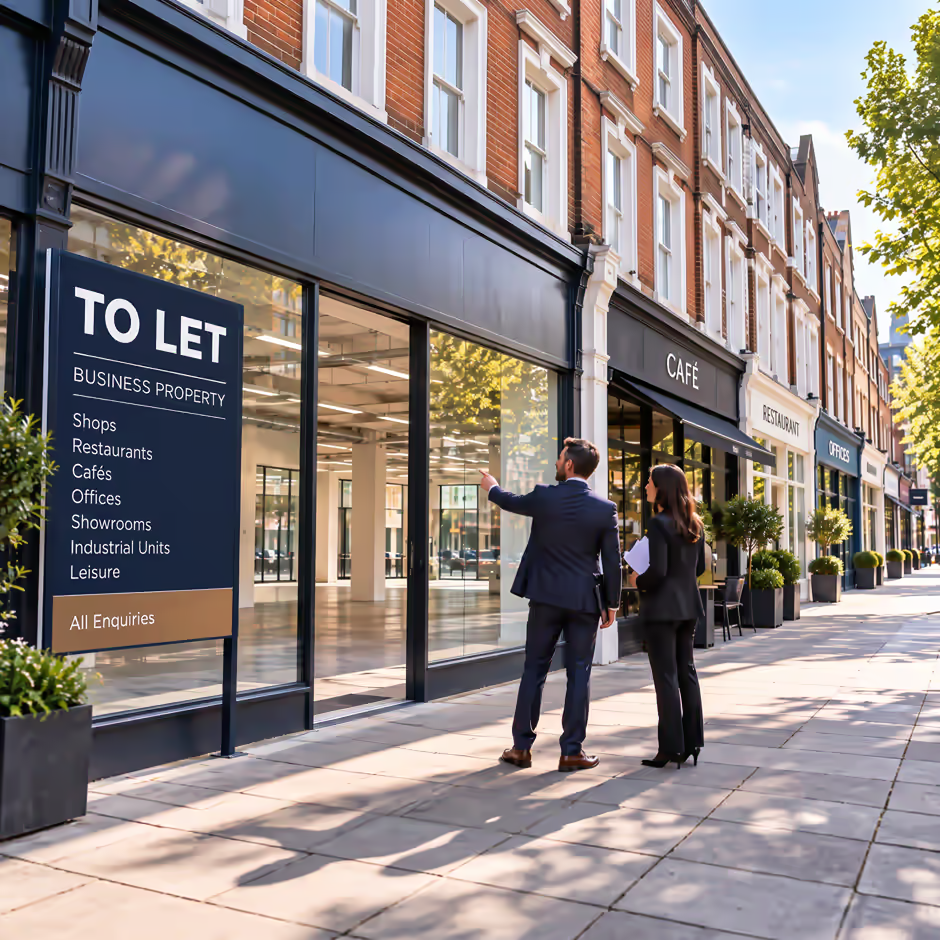
We arrange commercial property finance across the UK — whether you are buying the premises your business trades from or investing in commercial property for rental income.
Owner-occupier commercial mortgages
Buying the property your business trades from is one of the most financially sound decisions an owner-managed business can make. Rather than paying rent, you build equity in an asset that works for the business. We arrange owner-occupier commercial mortgages across the UK for a wide range of business types. The asking prices for leasehold and freehold commercial properties typically range from £250,000 to £2m.
Commercial investment properties
Commercial property investment — buying a retail unit, office, or industrial property for rental income — is assessed primarily on the rental yield and the strength of the tenant covenant. The UK offers a wide range of commercial investment opportunities across all price points.
Retail units and shop premises
Retail premises in established high streets and retail parades across the UK attract consistent tenant demand. Whether buying for owner-occupation or investment, the location, lease terms, and planning use class all affect how lenders structure the finance.
Office premises
Office properties across the UK — from small suites to larger floor plates — are acquired both for owner-occupation and investment. The quality of the fit-out, the lease structure, and the tenant's covenant strength are all assessed when structuring the commercial mortgage.
Industrial and warehouse premises
Industrial units, trade counters, and warehouse premises are consistently strong performers as commercial property investments, driven by logistics and last-mile delivery demand across the UK. Yields tend to be stronger than retail or office equivalents.
Mixed-use properties
Properties combining commercial ground floor use with residential above — flats, maisonettes, or HMO accommodation — are common across cities and towns nationwide. The mixed-use structure requires careful assessment of both the commercial and residential elements when structuring the finance.
03 — The transaction
What can we finance?
The Business Purchase
Funding to buy a trading business, including goodwill and the business assets.
The Freehold
Funding for the purchase of the premises from which the business operates.
The Leasehold
Funding to buy a business operating from leased premises.
Fixtures, Fittings and Equipment
Where appropriate, funding can also take account of the assets required to operate the business.
Working Capital
Depending on the transaction, we can arrange funding for the initial working capital required after you take ownership.
Every deal is assessed on its own merits — not every element of every purchase will be financeable, and we'll tell you plainly what is and what isn't.
04 — The lender's view
What will lenders look at?
Lenders want to see a professionally prepared funding application. They want to know that the business is viable, that the proposed borrowing is affordable and that their loan can be repaid as agreed.
We use our proven iLendi Six™ method to build a strong funding application around the things lenders need to understand about your purchase.
Read more about the iLendi Six™05 — The funding
How much can you borrow?
Every purchase is different. The amount you can borrow will depend on the business, its trading performance, the purchase price, your circumstances and the structure of the transaction.
For business property, lenders will focus on the valuation, the rental income or trading accounts supporting the borrowing, lease terms where tenants are in place, and the location.
We arrange funding and work with you to find the financing solution that best fits the purchase.
06 — The completion
The iLendi Approach
Three steps from finding the business to owning it.
01
The Discovery
You have just found the business you want. You tell us all about it.
02
The Finance
You need financing to buy the business; we find the money.
03
The Completion
We stay by your side through to legal work completion and the business is yours.
Common questions
Buying a commercial property — your questions answered
Is owner-occupier finance different from an investment purchase?+
Yes. An owner-occupier mortgage is structured around your business trading performance, while an investment purchase is assessed on rental yield and the strength of the tenant covenant.
How much deposit do I need to buy a commercial property?+
Most commercial property acquisitions are funded with a deposit of around 20% to 30% of the purchase price, though this varies with the strength of the trading figures, whether the deal includes freehold property, and your own experience. Where there is property security or a particularly strong trading history, lenders can sometimes go further.
Can I borrow against goodwill when buying a commercial property?+
Yes. Specialist acquisition lenders will lend against goodwill where the trading history supports it, which is essential for leasehold deals with no bricks-and-mortar security. The application has to be presented so the underwriter can see the sustainable, transferable earnings behind that goodwill.
How long does it take to arrange finance to buy a commercial property?+
Indicative terms are usually available within 48 hours of your enquiry. A full offer typically follows within two to four weeks, with completion driven mainly by valuation and the pace of the legal work on both sides.
Is iLendi Capital a lender or broker?+
iLendi Capital is an acquisition finance and loans broker, not a direct lender. We work with buyers across the UK to prepare their funding applications, introduce them to the lenders most likely to approve them, and manage the deal through to completion. We also specialise in government-backed facilities, helping you secure up to £2m toward your purchase.
Keep exploring
Related businesses we fund
Buyers of commercial property often look at these neighbouring sectors too.
Found your commercial property?
Let's find the finance.
Begin your funding process
Start with a conversation.
Tell us what you want to buy and an experienced funding specialist will call you back same day to discuss how we can help.
Other ways to contact us
Send an email:enquiries@ilendicapital.co.ukCall us: +44 (0)20 3488 8126We'll open WhatsApp with: "Hello iLendi Capital — I'm looking at buying a business and would like to talk."